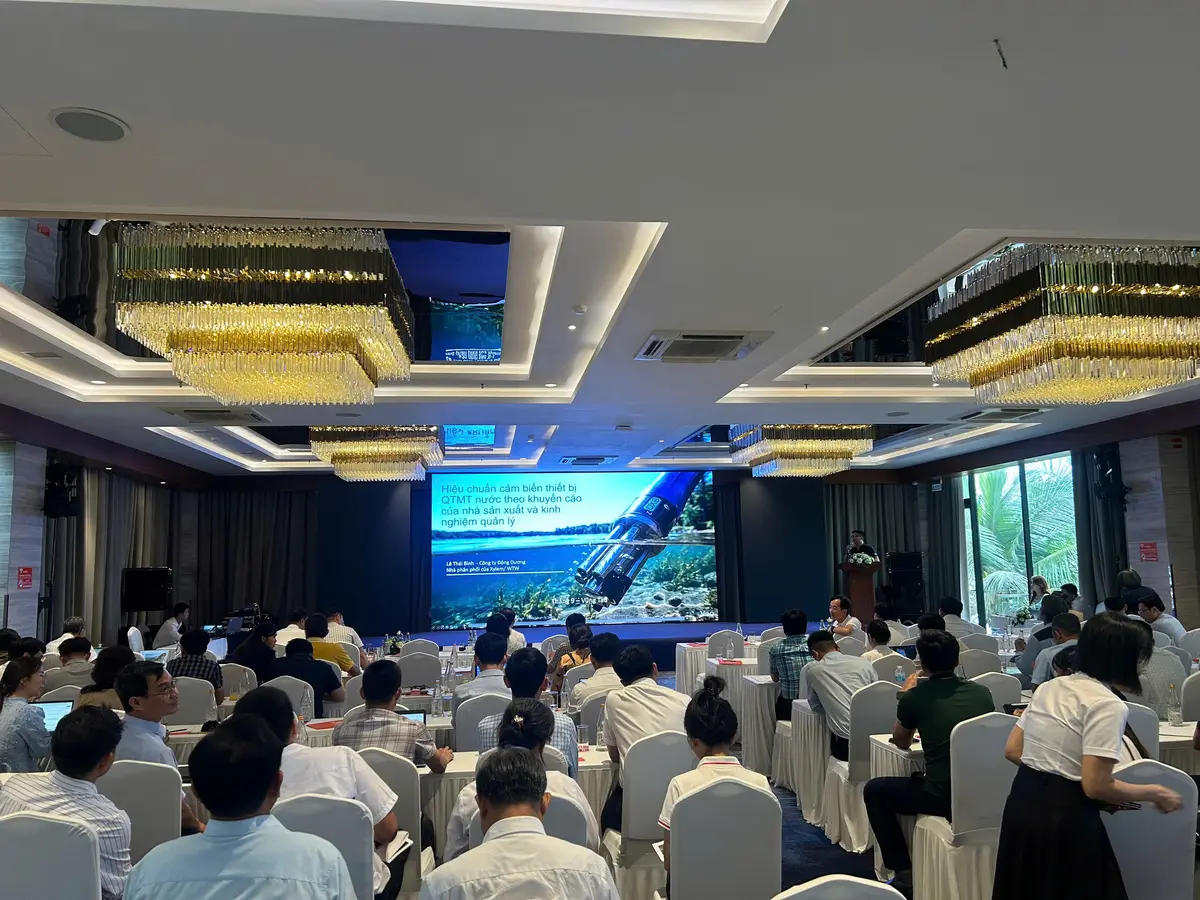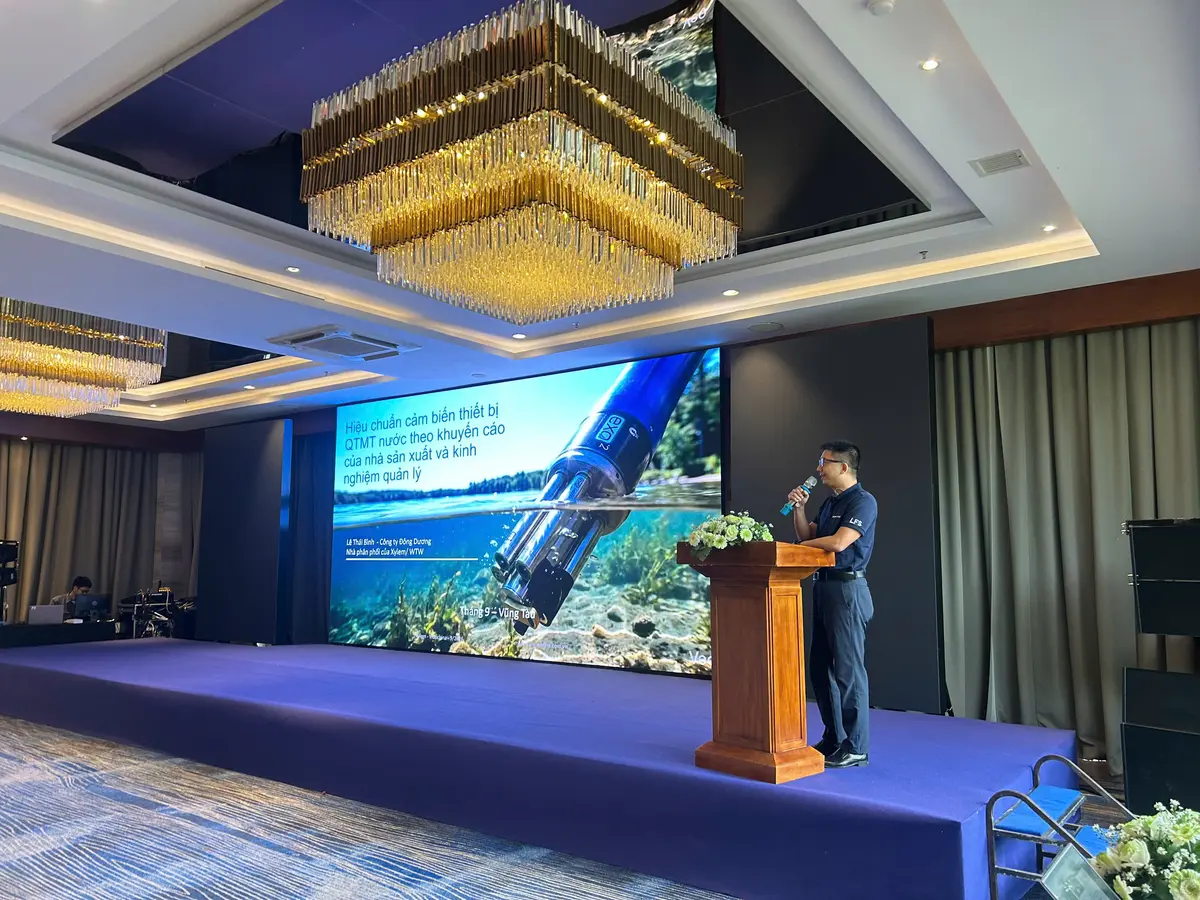
As a representative of WTW, Mr. Le Thai Binh brought the presentation "Calibration of sensors for water environment monitoring equipment according to manufacturer's recommendations and management experience" - an in-depth content, associated with the key problem of current automatic and continuous monitoring activities: how to collect monitoring data. really trustworthy.
The presentation starts from a fundamental principle: a reliable measurement result requires three types of evidence – the device is installed and configured correctly, the device operates according to its measurement characteristics, and most importantly, it is suitable for measurement on a real wastewater sample background. A standard laboratory test is necessary but not sufficient to confirm all three.
From practical operating experience and the manufacturer's technical recommendations, the presentation clarifies many characteristics of online sensors that are easily missed by the general inspection process. With the ion selective electrode (ISE) measuring ammonium and nitrate: the device measures ion activity, not directly the concentration, so it is greatly influenced by ionic strength, barrier ions (K⁺, Cl⁻) and temperature; At the same time, in terms of electrochemical nature, the electrode does not have an absolute "zero point" – testing the zero point can even cause deterioration or damage to the electrode. With the optical group measuring TSS: suspended particle characteristics (size, shape, density, color) are clearly different between each type of discharge, so a calibration coefficient is difficult to apply to all stations. The common point of both groups is: calibration against real sample background (matrix adjustment) is the link that determines the reliability of the data.
The paper also offers a constructive management perspective: the same parameter name (COD, TSS, ammonium) can be created from completely different measurement principles, so the inspection process needs to be classified according to technology instead of applying a common mold. In that spirit, the speaker proposed a process transparency in data correction - protecting the original data (raw), publicly recording the correction coefficient and audit trail, combining independent verification and relative accuracy assessment (RA). This approach allows adjusting the data to the actual while still controlling, retrieving and making legal evidence, and is completely based on Circular 10/2021/TT-BTNMT and the current Vietnamese Ministry of Foreign Affairs.
The comparison of wastewater monitoring regulations of Vietnam, the US, Thailand, China and Malaysia has provided a useful reference picture, helping management and operation units in the Southern region have more basis when completing censorship and data publication.
Indochina's participation at the conference continues to affirm its commitment to accompany management agencies, monitoring stations and businesses in improving the quality, reliability and transparency of automatic, continuous water environmental monitoring data - not only as an equipment supplier, but also as a reliable technical partner.
#DongDuong #WTW #Xylem #QuanTracMoiTruong #NuocThai #HieuChuan